Dental Associate Commission Calculation Without the Monthly Argument
Dental associate commission calculation, settled in advance: work billed or money collected, who carries the lab bill, and why the rate belongs on the item.
Four decisions make up a dental associate commission calculation, and the arguments happen when one of them was never written down: whether the percentage applies to work billed or money collected, how the lab bill is handled, what the rate is for each procedure, and what happens to last month's figures when you change that rate. Settle all four before the first pay run.
Should commission be on work billed or money collected?
On money collected, in almost every small clinic, and here is the trade-off you are accepting when you choose it.
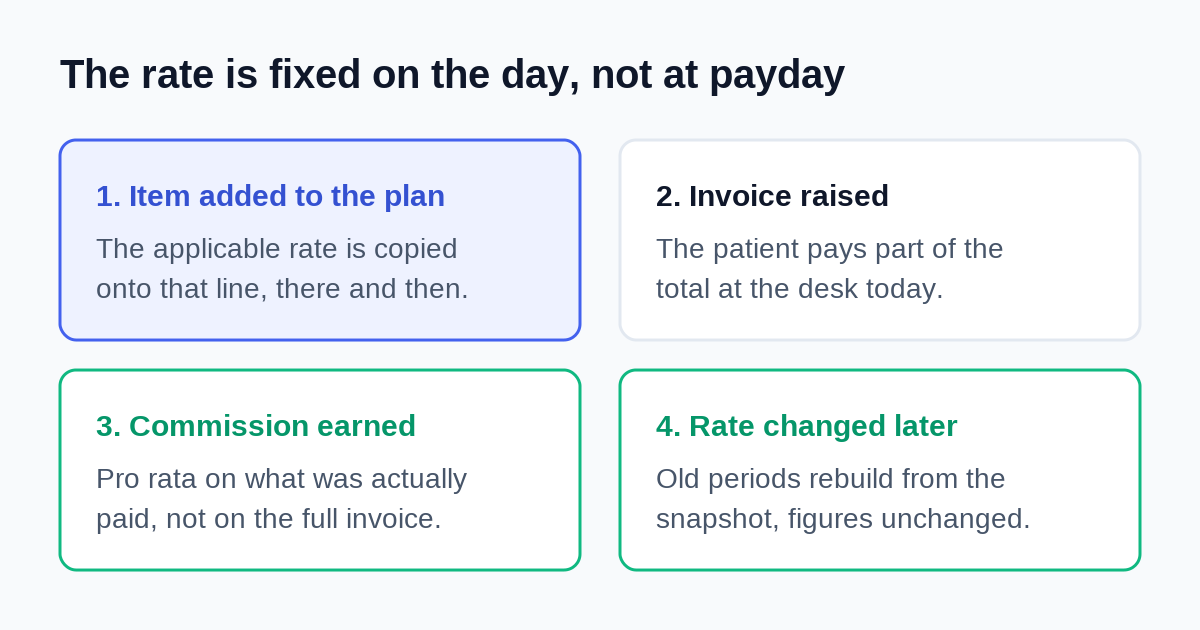
Paying on work billed is simpler and it pays the dentist promptly, but it hands the clinic every bad debt. The associate places a crown in March, earns on it in March, and you are still chasing the balance in July. Paying on money collected puts the risk back where the pricing and credit decisions are made, at the cost of the associate waiting. That wait is what sours the arrangement, so the usual fix is to pay on each payment as it lands rather than holding everything until an invoice closes in full. A patient who pays half of a treatment plan today earns the dentist half of the commission on it today.
Convention in the trade is a percentage of production or collections, sometimes with a guaranteed base in the early months. The American Dental Association's note on associate compensation sets out the common structures, though the percentages quoted there are United States figures and not a benchmark for your market. Your own number has to come out of your own overhead.
Who carries the lab bill on a crown?
Decide this before the first crown, not after it.
There are two workable conventions and they produce quite different payslips. Either the lab's invoice comes off the patient charge first and the percentage applies to what is left, or you pay a lower flat percentage on everything and absorb the lab cost yourself. Both are defensible. What is not defensible is applying the full percentage to the gross charge on a case where the lab took most of the money, discovering it in month three, and then trying to claw it back.
This is a practical argument for recording lab cases with the lab's cost and the patient's charge as separate figures. If the only number on the record is what the patient paid, nobody can reconstruct the deduction, and the conversation becomes a memory test.
What stops an argument about last month's figures?
Fixing the rate onto the work at the moment the work is recorded.
A commission rate that lives only on the staff profile is a rate that rewrites history every time you edit it. Change one person from 30 to 32 percent in June and every past period quietly recalculates, which is the single most common way these disputes start. The alternative is a snapshot: when a procedure is added to a treatment plan, the applicable rate is copied onto that line and stays there. Our payroll and commissions module works that way, and it keeps rate changes as a dated history so an old period reconstructs exactly.
One limitation worth knowing: that is one rate per person, or one per procedure, not a sliding scale that steps up when somebody passes a monthly target. If your agreement works that way, part of it stays on paper.
Common questions
Should nurses and hygienists earn commission as well?
They can, and in clinics where the nurse does the scaling it is common. The mechanism is the same, a rate against the items they are credited with, which means somebody has to be named on each item for it to work at all.
What if a patient abandons a plan halfway through?
Commission follows the money, so the associate keeps what was earned on the payments actually received and nothing on the rest. Chasing the remainder is a separate job, and our note on getting paid faster covers that side.
Commission figures and the till have to agree at the end of the month, which is easier if they already agreed at the end of each day: see the end-of-day cash count. To run a pay run against your own rates and see what it produces, start a free trial.
See CuspFlow run your clinic
Every feature, unlimited branches, 30-day free trial. No card required.